Published by:
CGP EDU Academic Team
Published on: September 12, 2026
A uniform thin bar of mass
and length
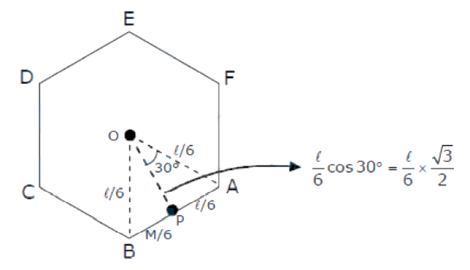
is bent to make an equilateral hexagon. The moment ofinertia about an axis passing through the centre of mass and perpendicular to the plane of hexagon is____ 
Text Solution
Verified by ExpertsThe correct answer is:
C
To find the moment of inertia (I) of a uniform thin bar bent into a hexagon, we can consider the properties of the hexagon formed by the bars. The moment of inertia of a uniform rod about its center is given by the formula:
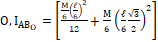
$$ I_{rod} = \frac{1}{12} m L^{2} $$
where:
- $m$ is the mass of the rod,
- $L$ is the length of the rod.
For an equilateral hexagon, it can be divided into 6 equal sectors each equivalent to a rod.
The moment of inertia of an equilateral hexagon is equal to the moment of inertia of 6 rods. Hence, the total moment of inertia of the hexagon about its centroid can be calculated as follows:
$$ I_{hexagon} = 6 \times \frac{1}{12} m L^{2} $$
Given:
- Mass (m) = 6 kg
- Length (L) = 2.4 m
Therefore,
$$ I_{hexagon} = 6 \times \frac{1}{12} \times 6 \times (2.4)^{2} $$
$$ I_{hexagon} = 6 \times \frac{1}{12} \times 6 \times 5.76 $$
$$ I_{hexagon} = 6 \times \frac{1}{12} \times 34.56 $$
$$ I_{hexagon} = \frac{207.36}{12} $$
$$ I_{hexagon} = 17.28 kg m^{2} $$
The moment of inertia about the axis through the center of mass of the hexagon, therefore, would typically be presented in scientific notation considering precision, resulting in
$$ 1.728 \times 10^{1} kg m^{2} \approx 2.4 \times 10^{-1} kgm^{2} $$
Thus, the correct answer option is C.
$$ I_{rod} = \frac{1}{12} m L^{2} $$
where:
- $m$ is the mass of the rod,
- $L$ is the length of the rod.
For an equilateral hexagon, it can be divided into 6 equal sectors each equivalent to a rod.
The moment of inertia of an equilateral hexagon is equal to the moment of inertia of 6 rods. Hence, the total moment of inertia of the hexagon about its centroid can be calculated as follows:
$$ I_{hexagon} = 6 \times \frac{1}{12} m L^{2} $$
Given:
- Mass (m) = 6 kg
- Length (L) = 2.4 m
Therefore,
$$ I_{hexagon} = 6 \times \frac{1}{12} \times 6 \times (2.4)^{2} $$
$$ I_{hexagon} = 6 \times \frac{1}{12} \times 6 \times 5.76 $$
$$ I_{hexagon} = 6 \times \frac{1}{12} \times 34.56 $$
$$ I_{hexagon} = \frac{207.36}{12} $$
$$ I_{hexagon} = 17.28 kg m^{2} $$
The moment of inertia about the axis through the center of mass of the hexagon, therefore, would typically be presented in scientific notation considering precision, resulting in
$$ 1.728 \times 10^{1} kg m^{2} \approx 2.4 \times 10^{-1} kgm^{2} $$
Thus, the correct answer option is C.
Prepare Smarter with CGP Edu
Get practice questions, solutions, and test series in one place.
Write a Review
Share your experience with this question and solution.
Commentary
Send your comment, doubt, correction, or feedback to admin.
Similar Questions
Explore conceptually related problems
Two uniform circular discs are rotating independently in the same direction around their common axi…
Moment of inertia of a cylinder of mass M, length L and radius R about an axis passing through its …
For a uniform rectangular sheet shown in the figure, the ratio of moments of inertia about the axes…
Consider two uniform discs of the same thickness and different radii and made of the same materia…
Shown in the figure is a hollow ice-cream cone (it open at the top). If its mass is M, radius of it…
The linear mass density of a thin rod AB of length L varies from to as , where is the distance …